

Dave Zanoni
One of the most common mistakes I see is judging a dog food entirely by its ingredient list. A bag covered in appealing ingredients may look impressive, but ingredients alone cannot tell us whether a food delivers the vitamins and minerals a dog actually needs.
I've seen foods with attractive ingredient panels and marketing-friendly recipes that still raised nutritional concerns. I've also seen foods with less glamorous ingredient lists deliver excellent nutrient profiles.
The goal isn't to choose foods with the prettiest label. The goal is to choose foods that consistently meet a dog's nutritional needs.
There is more to nutrition than naming good ingredients
Dogs require a range of nutrients to maintain normal growth, metabolism, immune function, tissue repair, and overall health. The National Research Council's Nutrient Requirements of Dogs and Cats is an important scientific reference on those requirements. AAFCO's nutrient profiles and FEDIAF's nutritional guidelines help turn that science into standards and recommendations for complete pet foods.
Consider what some of these nutrients actually do:
Calcium and phosphorus are involved in bone development, but they also have roles in other body functions. Magnesium is needed for numerous enzyme reactions. Sodium, potassium, and chloride are important for fluid balance, nerve function, and muscle activity. Iron is needed to make hemoglobin, which transports oxygen. Zinc supports skin health, wound healing, and enzyme function. Copper is involved in several enzyme systems and iron metabolism. Iodine is needed to produce thyroid hormones, while selenium participates in antioxidant defense.
Vitamins are just as important. Vitamin A is needed for vision and the maintenance of normal tissues. Vitamin D helps regulate calcium and phosphorus. Vitamin E helps protect cell membranes against oxidative damage. The B vitamins perform different jobs in energy metabolism, nervous system function, and the production of healthy cells. Choline also has important roles in cell membranes and fat metabolism.
Notice something about that list: none of those nutrients works entirely on its own. The amount matters, but so does the relationship between nutrients, their availability to the body, and how much food the dog actually eats.
Calcium is a good example of why more isn't always better
I often hear calcium described as something that builds strong bones. That's true, but feeding extra calcium is not a shortcut to stronger bones, particularly in a growing puppy.
Calcium and phosphorus need to be supplied at appropriate concentrations and in an appropriate ratio. Both numbers matter. A food can have a reasonable calcium-to-phosphorus ratio and still supply too much or too little of one or both minerals.
Growing large- and giant-breed dogs deserve special attention here. In a published experiment involving Great Dane puppies, researchers found skeletal changes in puppies given excessive calcium compared with those receiving the recommended amount. This was a controlled experiment, not proof that every high-calcium food will cause disease. But it demonstrated a very real risk of getting mineral intake wrong during growth.
There is another study I think is worth knowing about. Researchers tested mineral concentrations in 45 commercial dry dog foods marketed for maintenance. Thirty-nine met the AAFCO recommendations for every mineral measured, while six did not. Some had excessive calcium or phosphorus; others fell below the evaluated zinc recommendation. The researchers were looking at selected minerals in a limited group of products, not every nutrient in every dog food on the market.
Still, it makes an important point. The nutritional value of a finished food has to be evaluated, not assumed from its ingredient list.
Vitamin D shows why both deficiency and excess matter
People call vitamin D the sunshine vitamin. For dogs, that description can be misleading.
Research has shown that dogs do not produce adequate vitamin D through their skin the way people can. They depend on their diet for their vitamin D needs.
But that does not mean more vitamin D is better. Because vitamin D is fat soluble, excessive amounts can accumulate and cause serious problems. The FDA has warned that vitamin D toxicity in dogs can lead to kidney damage and, in severe cases, death.
So when I see people talking about adding vitamins to an already complete diet, I think it's fair to ask what deficiency they're trying to correct. If the food is properly formulated for the dog and is being fed in adequate amounts, adding a supplement without a reason may create an imbalance instead of solving one.
Essential does not mean unlimited.
Minerals can affect one another
Copper and zinc provide another useful example. Copper is essential, but some dogs are genetically susceptible to accumulating too much copper in the liver.
In a study of Labrador Retrievers, higher dietary copper and lower dietary zinc were associated with higher liver copper concentrations. This was a specific group of dogs, many with a family connection to copper-associated hepatitis. It would be wrong to take those findings and tell every dog owner to restrict copper.
What the research does show is that the amount of one mineral cannot always be judged in isolation from another, and that an individual dog's health and genetics can matter.
This is also why a diet designed for a dog with a diagnosed medical problem may have different nutrient targets from an ordinary maintenance food. Those decisions belong in a discussion with the veterinarian treating that dog.
What does complete and balanced actually mean?
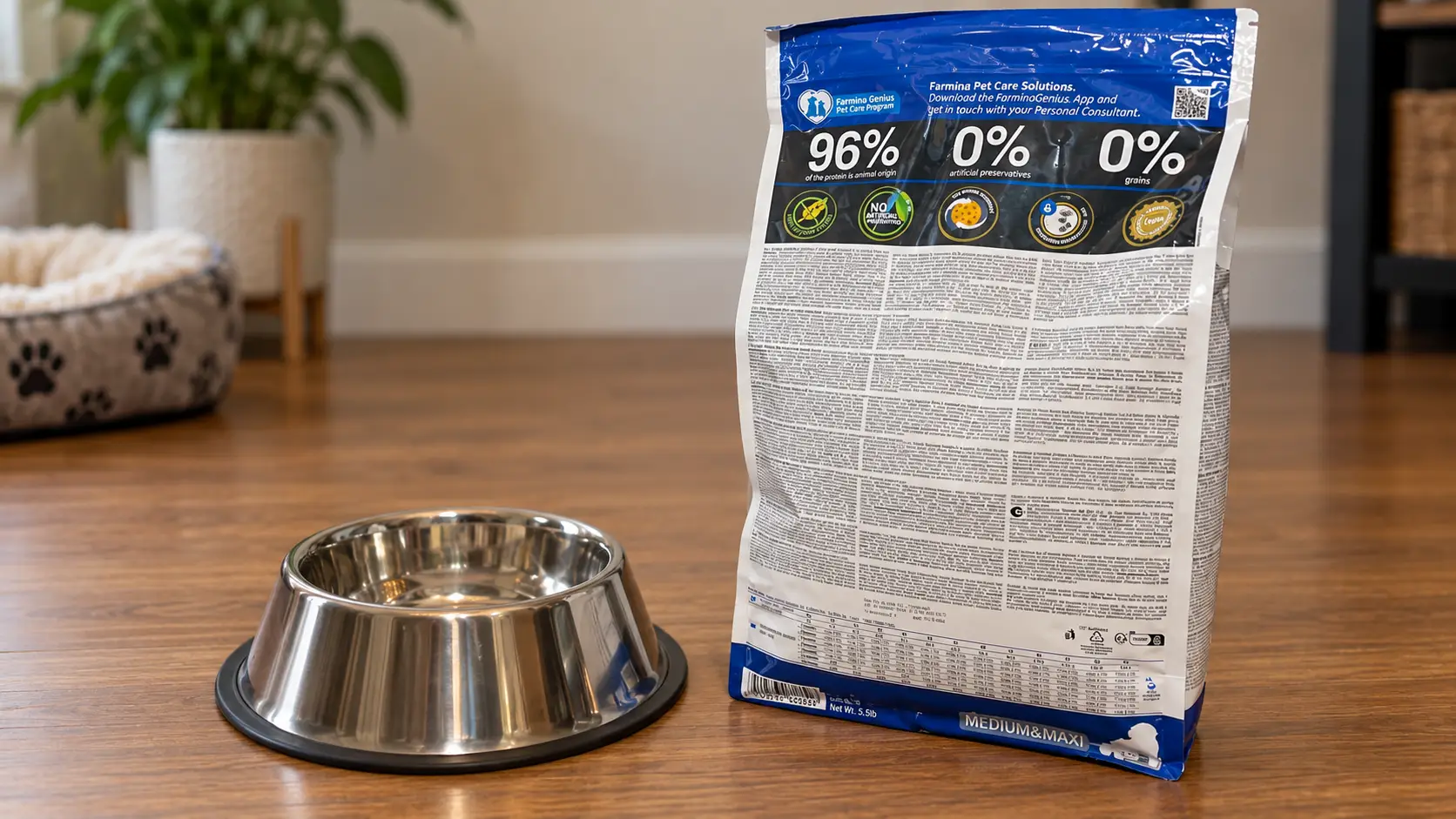
If you want to understand a pet food label, don't stop at the ingredients. Find the nutritional adequacy statement. It is usually printed in fairly small type on the back or side of the package.
In the United States, a food may state that it is formulated to meet the AAFCO Dog Food Nutrient Profiles for a particular life stage. Another statement may say that animal feeding tests using AAFCO procedures substantiate complete and balanced nutrition. There is also a less common statement for products substantiated through comparison with a product supported by feeding tests.
Those statements tell you how the manufacturer supports its nutritional adequacy claim. They do not mean AAFCO personally tested or approved the brand.
Life stage matters too. A food intended for adult maintenance is not necessarily suitable for growth. For large-breed puppies, pay close attention to whether the label says the food is appropriate for growth of large-size dogs.
And look closely when a product says for intermittent or supplemental feeding only. A topper or treat can be a useful part of feeding, but it should not be mistaken for a complete daily diet.
None of this means a complete and balanced statement answers every question about a food. It doesn't tell you everything about ingredient sourcing, digestibility, manufacturing consistency, or how a particular dog will respond. It is an important starting point, not the entire evaluation.
Why I don't rely on the guaranteed analysis alone
Many dog owners are familiar with the guaranteed analysis. It gives us minimums for crude protein and crude fat and maximums for crude fiber and moisture, along with any other required or voluntarily listed guarantees.
But a minimum is not an average, and a maximum is not an average either. The numbers on the label usually do not tell you the typical amount of every vitamin and mineral in the finished food.
When a more detailed comparison is necessary, I prefer to see the manufacturer's typical nutrient analysis. I also want to know how the numbers are expressed. Are they as fed? On a dry matter basis? Or per 1,000 kilocalories of metabolizable energy?
Those are not interchangeable measurements.
A simple phosphorus example
Let's say two hypothetical dog foods provide the following information:
Food A: 0.8% phosphorus as fed, with 4,000 kcal/kg.
Food B: 0.6% phosphorus as fed, with 2,500 kcal/kg.
At first glance, Food B looks lower in phosphorus. But when we account for calories, the comparison changes.
Food A supplies 2.0 grams of phosphorus per 1,000 kcal.
Food B supplies 2.4 grams of phosphorus per 1,000 kcal.
Food B has the lower as-fed percentage but supplies more phosphorus for the same number of calories. That's why I don't like comparing label percentages without knowing what they represent.
These are made-up numbers to demonstrate the calculation. They are not recommendations for any dog, and phosphorus guarantees should not be treated as exact laboratory averages. For a dog with kidney disease, the veterinarian's treatment plan and the complete nutritional profile matter far more than a single number.
I've made several free educational tools available on the Purrs McBarkin’ Pet Nutrition Tools page. They can help you compare food labels and understand dry matter values, but they are not a replacement for veterinary advice or a complete nutrient analysis.
What about fresh and home-prepared food?
I don't believe a food becomes nutritionally sound simply because it is dry, canned, raw, gently cooked, or homemade. Each approach has to be evaluated on its own merits.
Home-prepared diets are a good example of why formulation matters. A published study analyzed 75 recipes prepared for adult dogs and 25 for adult cats. None met all the recommendations for the nutrients evaluated, and more than 84% of the recipes were below recommendations for at least three of those nutrients.
Those findings apply to the diets studied. They do not mean every homemade diet is deficient. Properly formulated home-prepared diets are possible. The point is that choosing wholesome foods does not automatically produce the correct vitamin and mineral balance.
If someone wants to prepare a dog's entire diet at home, I encourage them to work with an appropriately qualified veterinary nutrition specialist and follow the formulation carefully. Small substitutions can change the nutritional outcome.
Where I come down on all of this
I am not dismissing the ingredient list. Far from it. I care about ingredient quality, manufacturing standards, unnecessary additives, and transparency. I want to know what is going into the bowl.
But I also want to know what the finished food is providing. If a manufacturer cannot explain its nutritional adequacy statement, supply meaningful nutrient information, or describe how it checks the consistency of its product, those are fair questions to raise.
A food does not earn my confidence just because the front of the bag looks appealing. And a vitamin or mineral premix is not automatically a bad thing just because its ingredients have scientific names. Those nutrients may be there for a very good reason.
The ingredient list tells part of the story. The nutritional analysis tells another part. We need both.
Our dogs cannot read food labels or question the claims printed on a package. We have to do that for them.
That's what I mean when I say: Feed with purpose, not guesswork.
Sources and further reading
For anyone who wants to dig deeper, these are the scientific publications and nutrition references used in preparing this article.
- National Research Council. Nutrient Requirements of Dogs and Cats. National Academies Press, 2006.
- Association of American Feed Control Officials (AAFCO). Reading Pet Food Labels. Guidance on ingredient lists, guarantees, and nutritional adequacy statements.
- AAFCO. Nutritional Labeling. Explanation of guaranteed analysis values and their limitations.
- FEDIAF. Nutritional Guidelines for Complete and Complementary Pet Food for Cats and Dogs. 2025 edition.
- Goedegebuure SA, Hazewinkel HAW. Morphological findings in young dogs chronically fed a diet containing excess calcium. Veterinary Pathology, 1986.
- Gagné JW, et al. Evaluation of calcium, phosphorus, and selected trace mineral status in commercially available dry foods formulated for dogs. Journal of the American Veterinary Medical Association, 2013.
- How KL, Hazewinkel HAW, Mol JA. Dietary vitamin D dependence of cat and dog due to inadequate cutaneous synthesis of vitamin D. General and Comparative Endocrinology, 1994.
- U.S. Food and Drug Administration. Vitamin D Toxicity in Dogs.
- Fieten H, et al. Association of dietary copper and zinc levels with hepatic copper and zinc concentration in Labrador Retrievers. Journal of Veterinary Internal Medicine, 2012.
- Pedrinelli V, et al. Concentrations of macronutrients, minerals and heavy metals in home-prepared diets for adult dogs and cats. Scientific Reports, 2019.
Educational note: This article provides general canine nutrition information. It does not diagnose medical conditions or prescribe treatment. Dogs with diagnosed diseases, abnormal laboratory results, or specialized nutritional needs should be evaluated by a veterinarian. A board-certified veterinary nutritionist can help with complex diet formulation.